Affording and Finding Care
Community Walking Tracks
Use a community walking track well: weekly minutes, safe seasons, walking with children and how routine movement supports health.
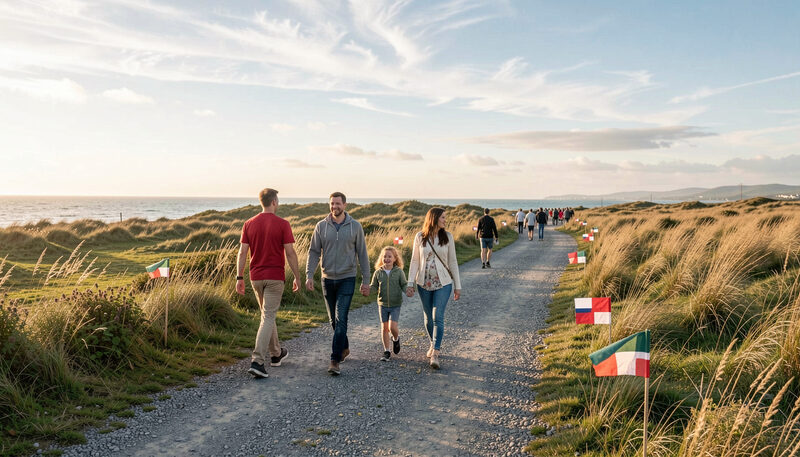
A community walking track is the simplest piece of health infrastructure a town owns: a measured loop, open in every season, free at the door.
How much walking is recommended?
The Centers for Disease Control and Prevention recommend that adults accumulate at least 150 minutes of moderate intensity activity each week, and a brisk walk is the standard example of moderate intensity. On a measured track that arithmetic becomes simple: about thirty minutes on most days, roughly two miles at a walking pace, or three quarters of an hour five mornings a week. Children need more, a full hour of activity daily, which they collect at recess, in the yard and on the same loops their parents use. The numbers are floors rather than targets, and the health benefit starts below them: the best evidence ranks any regular movement above none, and ranks consistency above intensity.
Why does a track beat the open road?
Because a loop removes the decision. A walk on roads demands a route, an out and a back, and the option to shorten at every corner, while a track is always the same known quantity, measured, flat or gently rolling, and closed to traffic. The measured distance turns effort into arithmetic, laps into miles, which is the same quiet bookkeeping that home blood pressure logs and symptom diaries perform for the annual physical. A track also carries company: the same faces at the same hour, which is the mechanism by which exercise habits survive bad weeks, documented wherever walking groups are studied.
How does a family walk with children?
With lower expectations and better accessories. Small children walk a loop, ride a stroller, and stop for every interesting stone, and the parent who plans for the stops keeps the habit alive where the parent who insists on pace kills it. School age children turn laps into games: timing a mile, counting birds, racing the last straight. Teenagers accept the track more readily when it comes with a purpose, a podcast, a phone call, the family dog. The household rule that carries years is modest: the whole family goes, everyone moves at their own pace, everyone finishes. The same gentle scaffolding that makes a first dental visit work for a toddler makes the track work for her brother.
What does a coastal year do to the routine?
A Downeast year redistributes the walk rather than cancelling it. Summer brings heat that argues for morning laps and long evening light; autumn is the season the track was built for; winter shortens the days and moves the walk to midday or under lights where a town has them, with traction devices in the boot bag for ice; spring delivers mud and the return of company. Indoor substitutes cover the worst weeks: school gyms open to the public in some districts, big box stores serve as impromptu walking halls in a pinch, and stair work at home answers the intensity question. The winter that stops a walking habit is a planning failure rather than a weather event, the same planning that protects the year of medical appointments in the household care plan.
What does regular walking do for health?
It supports the cardiovascular numbers, blood pressure, weight, blood sugar, that the annual physical measures, and the Centers for Disease Control and Prevention list reduced risk of heart disease and type 2 diabetes among the benefits of meeting the activity floor. It supports mood and sleep with an evidence base that places it alongside, not behind, more formal interventions for mild low mood, which is why a counselor will often pair the appointment with the routine, as the mental health guide notes. None of this makes a walk a treatment on its own, and none of it needs to: the walk is the floor under everything else, cheap, available and cumulative.
How does a walking routine meet the clinic?
As data and as companions. A household that logs its weekly minutes brings a number to the visit that the clinician can actually use, the way the food diary and the home pressure log are used, and the log needs no device more advanced than a wall calendar. The routine also slots into the community life that surrounds the clinics described in the affording care guide: walking groups meet through hospitals, churches and senior centers in most counties, hospital sponsored programs being a quiet pillar of rural prevention. Walking with the group that meets at the school parking lot converts the solitary chore into the standing appointment, which is the form of exercise that survives.
How is a track program started or revived?
Through the doors a small town already has. Schools open tracks to the community outside school hours in many districts, a decision made at a school board meeting rather than a clinic. Recreation committees and health coalitions maintain the surfaces, light the loops and post the mileage markers, and the same meetings welcome a resident who asks. The former health center that kept this domain maintained its track page because the track belonged to the town's health as surely as the clinic did, and a town that loses its track page to a domain change loses a pointer, not the path.
Find the loop, fix the hour, log the laps on the calendar by the door, and let the arithmetic do the motivating. The Centers for Disease Control and Prevention publish their activity recommendations, for adults and for children, at the physical activity basics pages, which hold the numbers behind every mile above.