Family Medicine Basics
Your First Visit
Prepare a first appointment at a family practice: papers to bring, insurance questions, intake forms and what happens during the visit.
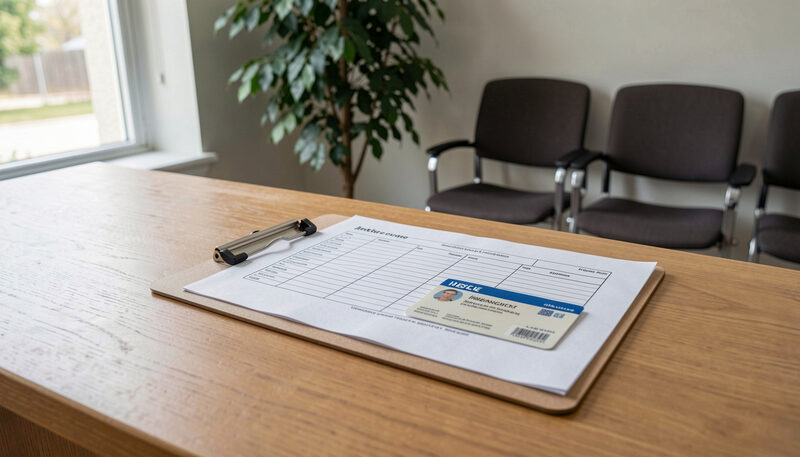
A first visit to a new family practice sets the tone for years of care, and it rewards an hour of preparation more than any other appointment. This page, kept at its historical address, walks through the whole visit in order: what to gather beforehand, what the paperwork asks, what happens in the exam room, and which questions turn a routine intake into a useful start. The guidance is general, written for rural households in the United States, and replaces nothing a clinician says in person.
What should a new patient bring?
The waiting room desk can only register what it receives, and missing papers are the main reason first visits run late. The useful stack is short: photo identification, current insurance cards if the household has coverage, a list of every medication with doses including vitamins and anything bought without a prescription, the vaccination record for children, and any letter from a previous clinician or specialist. Households without insurance should still come, and should ask at the desk about the sliding fee scale, since community health centers adjust their bills to income. The guide on payment options and the sliding fee scale explains that system and the proof of income it needs.
Why does the intake paperwork ask so much?
The forms handed over at a first visit ask for family history, past surgeries, allergies, medications and lifestyle questions such as tobacco and alcohol use. Each answer feeds decisions made months later, from which screening is due to which antibiotic is safe. Honest answers matter more than tidy ones, and uncertainty is an acceptable answer: writing "father, heart attack at fifty-two, details unknown" gives a clinician more to work with than a blank line. People who fill the forms at the practice rather than through the portal should arrive ten minutes early, since a rushed history is a thin history. Arriving with dates already written down, as recommended in the family medicine basics, keeps the first visit inside its scheduled time.
What happens in the exam room?
After the paperwork, a nurse or medical assistant records height, weight, blood pressure and pulse, and confirms the medication list aloud, a step designed to catch errors before they reach the chart. The clinician then asks the reason for the visit, reviews the history, and performs an exam that usually listens to heart and lungs, checks the abdomen and looks at whatever brought the patient in. A first visit often includes basic laboratory work, ordered on site or at a nearby lab, and a first conversation about the screenings the age group calls for. That conversation, and the schedule it produces, is developed in the annual physical guide, which lists what a complete preventive exam covers and how often each part comes due.
Which questions are worth asking?
A first appointment usually ends with a moment where the clinician asks whether anything else needs covering, and that moment is worth preparing. Three questions serve almost every new patient. Which screenings or vaccines are due now, and when should the next ones happen? Which hospital or specialist does the practice send patients to, and how does that referral work? How does the practice prefer to be reached for routine questions, prescription renewals and results? The last question matters more than it sounds, because practices differ: some answer the telephone quickly and treat the portal slowly, others live in the portal. The answer tells a household how to use the patient portal and the telephone line well for everything that comes after the first visit.
How do records follow a family to a new practice?
Records do not move by themselves. At the first visit, the desk gives a release form that authorizes the previous practice to send its chart forward, and signing it early shaves weeks off the wait. Until the old records arrive, the household copy described above, medications, vaccines, hospital letters, carries the load. Families moving between states should keep vaccination records on paper for each child, since school and sports registrations ask for them faster than offices can mail them. After a few weeks, a short portal message asking whether the records have arrived closes the loop, and starts the habit of checking the chart rather than assuming it.
What about confidentiality at a first visit?
Everything said in the exam room stays inside the medical record, protected by federal privacy rules that apply to every practice, and adolescents in many states hold specific rights over their own visits for sensitive services. The notice of privacy practices handed out at registration explains the rule and its rare exceptions, and questions about it can be raised with the desk or the clinician directly, since a clear answer at the start prevents hesitation later. Adults who want a family member to speak for them, an aging parent for example, can name that person in writing while they are at it.
How should small children be prepared?
Toddlers do better at a first visit when the trip is described at home in plain words, the stethoscope is not a surprise, and a familiar book or toy travels in the bag. Scheduling around naps and feeding times does more for the visit than any bribe, and parents who stay calm during vaccinations model the reaction they want. For the dental side of a first appointment, which has its own rhythm and its own fears, the guide to the first dental visit by age one applies the same preparation ideas to the dentist's chair.
Bring the papers, write the history down, ask the three questions, and sign the release. That short list is what a first visit really asks of a household, and it is the base every later visit stands on. MedlinePlus, the consumer library of the United States National Library of Medicine, publishes practical advice on talking with a doctor and preparing for appointments, which expands on every step above.